This guide is general reference, not a service manual. Intervals, torques and fluid specifications vary by engine rating, build and duty, and the manufacturer's own operation and maintenance manual is the authority. Part numbers change with serial number — send us yours and we will confirm the right parts before you order.
The Caterpillar C32B is a 32.1-litre V12 marine diesel engine with twin turbochargers, air-to-water aftercooling and Caterpillar's HEUI electronic unit injection, rated up to 1,925 hp (1,435 kW) at 2,300 rpm. It is fitted to sport-fishing yachts, express cruisers, fast crew boats and patrol craft, and to commercial vessels at continuous-duty ratings. This guide sets out the engine's specifications and ratings, Caterpillar's service intervals, the parts each interval calls for, the faults most often seen in service, and the spares worth carrying on board.
Engine overview
Key specifications
Configuration: 12-cylinder, 60° V-engine
Power output: 1,925 hp (1,435 kW) at 2,300 rpm, rating dependent
Displacement: 32.1 litres (1,959 cubic inches)
Bore and stroke: 145 mm x 162 mm
Aspiration: twin turbochargers, one per bank, with air-to-water aftercooling
Fuel system: ACERT technology with HEUI (hydraulic electronic unit) injectors
Cooling system: closed fresh-water circuit with heat exchanger
Dry weight: approximately 2,900 kg
Emissions: IMO II compliant, rating dependent
Oil pressure, running: 275–415 kPa (40–60 psi)
Coolant temperature: 82–96°C (180–205°F)
Air inlet restriction: 635 mm H2O maximum
Exhaust back-pressure: 76 mm Hg maximum
Power ratings
Pleasure craft: 1,925 hp (1,435 kW) at 2,300 rpm for high-performance yachts; 1,800 hp (1,342 kW) at 2,300 rpm standard
Commercial, continuous duty: 1,600 hp (1,193 kW) at 1,800–2,100 rpm for workboats; 1,400 hp (1,044 kW) at 1,800 rpm for heavy-duty continuous operation
Parts specifications can vary by rating, so part numbers must always be confirmed against the engine serial number.
Typical applications
Sport-fishing yachts of 50–80 ft and tournament sportfish vessels
Express cruisers and motor yachts
Fast crew boats and patrol craft
Tenders and chase boats
Commercial fishing vessels
Charter yachts
ACERT technology meets its emissions standard without SCR or DEF and improves on the fuel efficiency of the C32A. The twin turbochargers reduce lag, sharpen throttle response, lower exhaust gas temperatures and give redundancy: the engine can be brought home on one turbocharger if necessary.
Service intervals
First 50 hours
Break-in service.
First oil and filter change
Inspect all connections and fittings, and check for leaks
Verify cooling system operation
Inspect belt tension
Torque all external fasteners
Verify there are no unusual noises or vibrations
Every 250 hours
Or every three months, whichever comes first.
Engine oil and filter change
Fuel filter replacement, primary and secondary
Inspect the raw-water pump and impeller
Check the crankcase breather
Visual inspection of all systems
Check coolant level and concentration
Inspect belts for wear and correct tension
Check for fluid leaks
Every 500 hours
Or every six months.
Complete oil and filter change
Replace all fuel filters
Replace air filter elements
Replace the raw-water pump impeller
Inspect turbochargers for leaks
Check all hose connections
Inspect heat exchanger anodes and replace if more than 50 per cent depleted
Sample and test coolant
Clean the crankcase breather, or replace it if of the disposable type
Every 1,000 hours
Or annually. All 500-hour items, plus:
Replace the coolant filter and conditioner
Inspect valve lash and adjust if needed
Compression test, recommended
Replace serpentine belts
Inspect and clean the heat exchanger
Test all sensors and alarms
Inspect engine mounts and check the damper plate and coupling
Full cooling system inspection
Inspect turbocharger wastegate operation
Every 2,000 hours
Or every two years. All 1,000-hour items, plus:
Replace all coolant with a complete flush
Inspect fuel injectors and check the HEUI system
Turbocharger inspection for bearing play and seal condition
Inspect the aftercooler, with pressure test and cleaning
Replace all serpentine belts
Timing gear inspection
Complete electrical system check
Load bank test where possible
Every 4,000 hours
Major overhaul.
Cylinder head inspection or reconditioning
Injector replacement, a complete set recommended
Turbocharger rebuild or replacement
Major bearing inspection and complete valve train inspection
Replace all seals and gaskets
Complete engine survey
Maintenance parts by system
Lubrication
Oil capacity: approximately 98 litres (26 gallons) with filters
Oil specification: API CJ-4 or CK-4 minimum and Cat ECF-3; SAE 15W-40 for normal operation (5°C to 50°C), SAE 10W-30 for cold climates (-18°C to 40°C); API CI-4 and older specifications must not be used
The HEUI system uses engine oil at over 3,000 psi to actuate the injectors, so oil quality and change intervals are critical: never extend the 250-hour interval, change the oil warm, and inspect old filters for metal particles
Primary oil filters: two per engine, replaced at every oil change with genuine Caterpillar filters; a collapsed filter means engine failure
Fuel system
Primary fuel filter (water separator): replace every 250 hours; check the water bowl daily and drain water immediately when detected; genuine Cat fuel/water separator
Secondary fuel filter: the final filtration before the injectors; genuine filters only
Priming: after any filter change, use the hand primer until fuel flows without bubbles; air in the HEUI system causes hard starting and rough running
HEUI injectors: electronically controlled and hydraulically actuated by engine oil at over 3,000 psi, with multiple injection events per cycle; expected life 12,000–15,000 hours in normal operation, 6,000–8,000 hours with poor fuel and 3,000–5,000 hours with contaminated oil; signs of trouble are rough running or misfiring, black smoke, loss of power, high fuel consumption, hard starting and unusual knock
Air intake and turbocharging
Air filter elements: heavy-duty marine type; replace every 500 hours minimum, more often in dusty environments; check the restriction indicator at every inspection; a restricted filter costs power and raises exhaust gas temperature
Turbochargers: inspect at every 500-hour service for oil leaks at the seals, whistling or grinding, wastegate operation and equal boost between banks; expected life 10,000–15,000 hours in normal operation, 5,000–8,000 hours with poor maintenance; failure shows as excessive black smoke, blue smoke from oil through the seals, unusual noise and unequal exhaust temperatures between banks
Aftercooler: air-to-water type integrated with the cooling system; inspect for leaks at the annual service, clean the sea-water side where applicable, and pressure test at major services
Cooling system
Design: fresh water cools the engine and aftercooler; raw sea water cools the fresh water through the heat exchanger; an expansion tank maintains system pressure
Coolant: Cat Extended Life Coolant (ELC) only, pre-mixed 50 per cent concentrate and 50 per cent distilled water, never mixed with standard coolant; system capacity approximately 135 litres; replace every 2,000 hours or three years; ELC protects aluminium components, prevents liner cavitation and is required by the HEUI system, and the wrong coolant voids the warranty
Coolant filter and conditioner: carries the supplemental coolant additives; replace at 1,000-hour intervals to prevent liner pitting
Raw-water pump: engine-driven with a rubber impeller; replace the impeller every 500 hours, more often in sandy or silty water; fit with glycerine or soapy water, inspect the housing for wear and debris, replace the faceplate gasket every time, and confirm every vane is present on the old impeller; a spare kit should always be on board
Heat exchanger: large tube-and-shell type with sacrificial anodes; inspect anodes every 500 hours and replace at 50 per cent depletion; clean tubes annually in salt-water service; scale build-up causes overheating
Drive and electrical
Serpentine belts: drive the twin alternators, raw-water pump, coolant pump and power-steering pump where fitted; inspect tension every 250 hours with a gauge, not by thumb pressure; check for cracks, glazing and fraying; replace every 2,000 hours minimum or immediately if damaged; too loose slips and under-cools, too tight fails pulley bearings
Damper plate and flexible coupling: absorbs torsional vibration; inspect at the annual service for cracks, wear and bolt torque; typical life 8,000–12,000 hours; failure shows as vibration and noise
Batteries and starter: a large bank, typically four 8D batteries, must hold voltage during cranking; heavy-duty marine starter
Sensors: coolant temperature, oil pressure, boost pressure, throttle position, engine speed and exhaust temperature sensors should be genuine Cat items
Common faults and their causes
HEUI system faults
The most complex fault on the C32B.
Symptoms: rough running, misfiring, black or white smoke, ECM fault codes
Causes: contaminated engine oil, the wrong oil specification (CI-4 instead of CJ-4), extended oil-change intervals, poor fuel quality, water in fuel, low oil pressure, a worn high-pressure oil pump
Prevention: Cat CJ-4 or CK-4 oil changed at 250 hours with genuine filters, correct oil level, clean fuel, and low oil pressure addressed immediately
Parts affected: injector set, high-pressure oil pump, ECM
Turbocharger faults
Symptoms: unequal power between banks, black or blue smoke, whistling or grinding, high exhaust gas temperatures, oil leaks from the seals
Causes: oil starvation or contamination, restricted air intake, excessive exhaust back-pressure, foreign-object damage, wear at high hours
Prevention: oil level and quality, air filters on schedule, an unrestricted exhaust, one to two minutes of warm-up before load and three to five minutes at idle before shutdown; caught early, a rebuild is possible, but running on failed seals means replacement
Cooling system failures
Failed raw-water impeller: vanes crack, break off or deform; total failure stops raw-water flow and the engine overheats within two to three minutes, severely enough to warp cylinder heads; replace every 500 hours without exception and check every vane is present on removal
Blocked heat exchanger: salt deposits, scale and debris reduce cooling capacity; clean annually in salt water, flush with fresh water after sea-water use and pressure test at major services
Depleted anodes: galvanic corrosion and tube failure follow; inspect every 500 hours, replace at 50 per cent depletion, use the correct anode material for the water and never run without them
Fuel contamination
Symptoms: corrosion in the injection system, injector failure, high-pressure pump damage, ECM sensor errors, rough running
Causes: condensation in tanks, poor marina fuel, a leaking tank vent, contaminated deliveries, a failed deck-fill cap seal
Prevention: fuel stabiliser or biocide, tanks kept full to limit condensation, the water separator checked daily and drained immediately, tanks polished annually, reputable fuel sources only
Electronic and sensor faults
Symptoms: intermittent alarms, limp mode, safety shutdowns, erratic gauges, the check-engine light, stored fault codes
Causes: vibration, heat, moisture intrusion, connector corrosion, age
Prevention: clean, dry connectors with dielectric grease, regular wiring inspection, corrosion addressed immediately, genuine Cat sensors only
Diagnosis needs Cat ET (Electronic Technician) software, which reads fault codes, monitors live parameters and adjusts engine parameters
Starting system faults
Symptoms: slow cranking, clicking, no response, grinding
Causes: weak batteries, low voltage or a bad solenoid, a faulty starter or connections, starter drive or flywheel damage
Prevention: batteries maintained and tested, connections clean and tight, no more than 30 seconds of cranking with a two-minute cool-down between attempts
Recommended spares
On-board spares kit
Complete fuel filter sets, two
Raw-water impeller kits with gaskets, two
Engine oil filters, four
Air filter elements, one complete set
Serpentine belts, complete set
Heat exchanger anodes, four
Fuel priming pump rebuild kit
Thermostat with gasket and water pump seal kit
A selection of common sensors
Injector O-ring kit
Assorted hoses, clamps and gaskets
Engine oil (Cat CJ-4 or CK-4), 100 litres or more; Cat ELC concentrate, 20 litres; fuel biocide; Cat gasket sealant; thread locker; electrical connectors, terminals and fuses of all ratings
Impeller removal tool, belt tension gauge, coolant refractometer, fuel pressure gauge, multimeter and the Cat service manual
Extended-passage additions
Complete serpentine belt tensioner
Fuel transfer pump
ECM
High-pressure oil pump seal kit
Turbocharger oil feed line
Troubleshooting
Engine will not start
Check the fuel supply, tank level and shut-off valve, and battery voltage (24 V minimum for cranking)
Check for air in the fuel system after a filter change and prime the HEUI system
Check oil pressure: the HEUI system will not operate without it
Read ECM fault codes; check the fuel supply pump, sensors and the glow-plug system on a cold start
Loss of power
Check the air filter restriction indicator and fuel filter restriction
Check boost pressure on both turbochargers and the exhaust for restriction
Note the exhaust smoke colour; consider HEUI injector faults
Overheating
Check the coolant level in the expansion tank, raw-water flow at the overboard discharge and the impeller
Check anode condition, belt tension on the coolant pump and coolant concentration
Consider a blocked heat exchanger, a thermostat stuck closed or air in the system
Abnormal smoke
Black: rich mixture, no boost from a turbocharger, injector faults, excessive load
Blue or grey: burning oil from turbocharger seals, valve guides or seals, piston rings, or excessive crankcase pressure
White: coolant entering combustion through a head gasket or cracked head, or raw fuel from an injector O-ring leak; normal briefly at a cold start
Low oil pressure
Stop the engine immediately if pressure falls below 140 kPa (20 psi) at operating rpm
Check the oil level, gauge accuracy, pressure sensor, filter restriction and pump operation; consider bearing wear, oil diluted with fuel or coolant, or the wrong viscosity
Fault codes
Common codes: 94-01 coolant temperature sensor; 100-03 oil pressure sensor; 253-02 to 253-14 injector circuits 1 to 12; 341-02 boost pressure sensor
Record all active and logged codes and the conditions when they appeared; do not clear codes before diagnosis; use Cat ET and address codes in order of severity
Model comparison
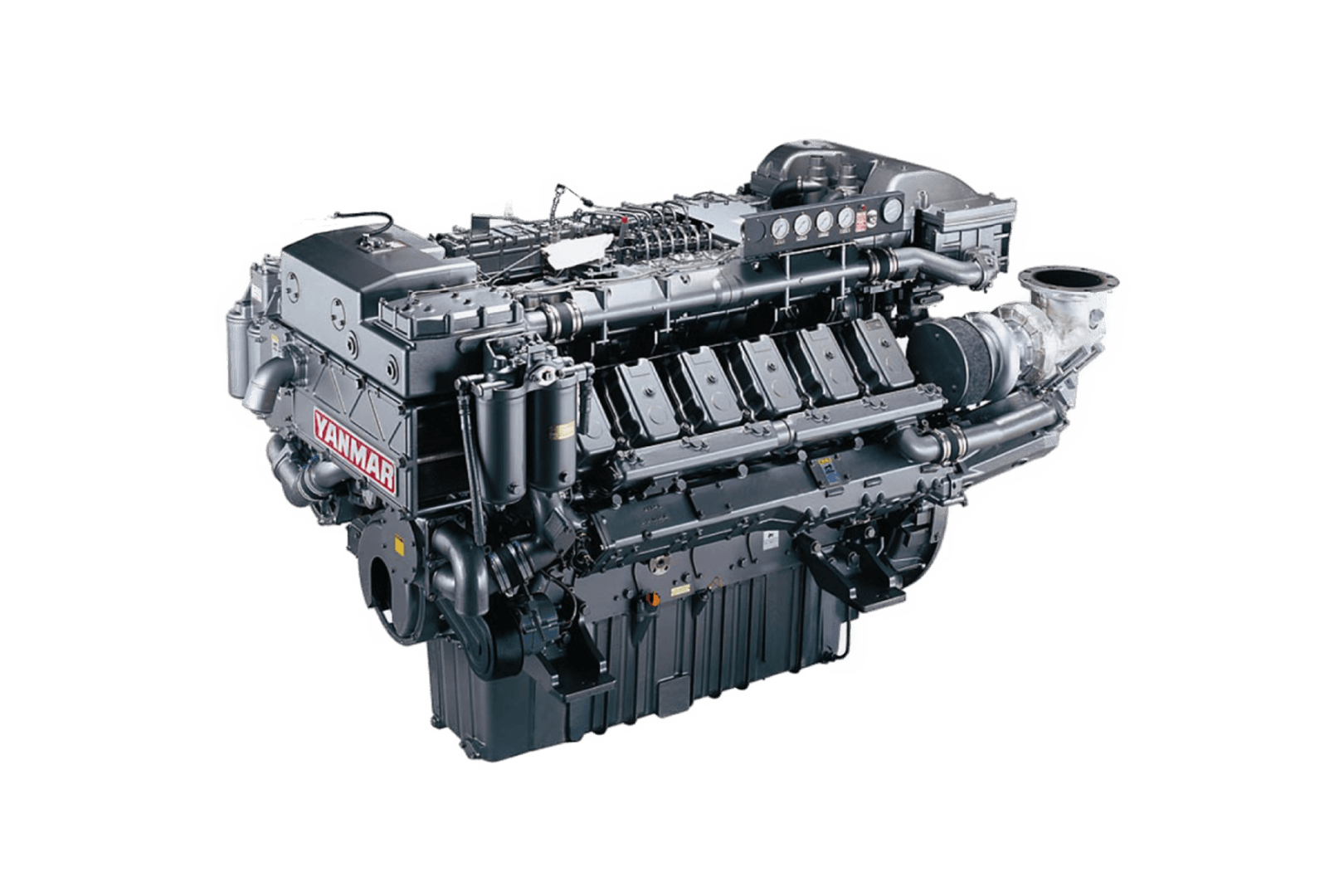
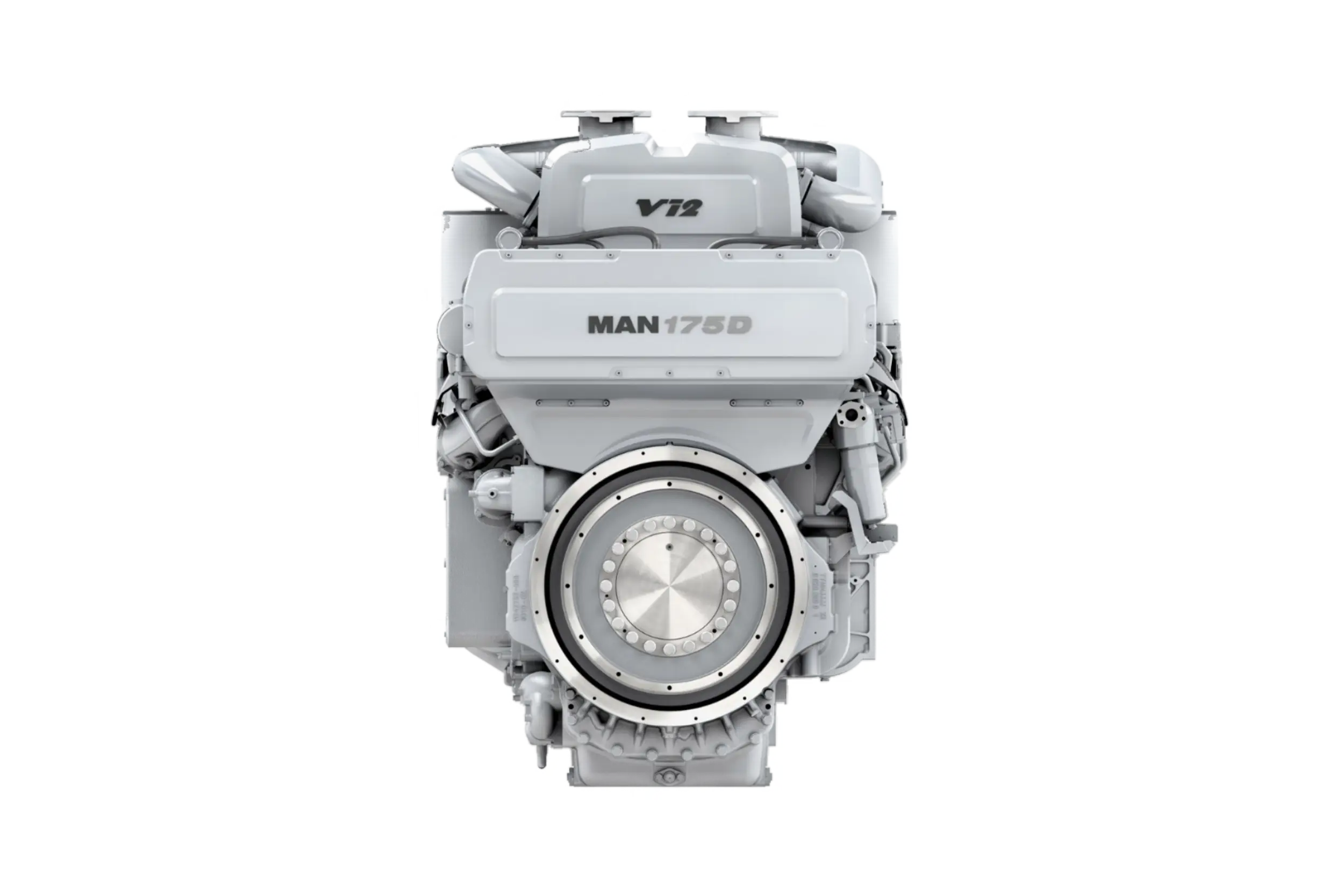
Against engines of similar output, the C32B offers the HEUI injection system, twin turbochargers, ACERT emissions with no DEF, Caterpillar's dealer network and documentation, and strong resale value. The MTU 12V 2000 M96 (1,948 hp) runs at higher rpm with common rail injection and lighter weight; the MAN V12 (1,800–2,000 hp) has similar displacement with common rail injection; the Yanmar 12AYM series (1,822 hp) offers slightly lower power with exceptional torque. The C32B's HEUI system demands strict maintenance and a critical oil specification, injector replacement is costly, and it is neither the lightest nor the most fuel-efficient option in its class.
Genuine parts
The HEUI system works to tolerances measured in microns, with engine oil actuating the injectors at over 3,000 psi. A non-genuine injector with the wrong hydraulic characteristics or spray pattern performs poorly, fails early and can contaminate the whole system; non-genuine fuel and oil filters may collapse under pressure, pass contaminants, restrict flow or leak, and the two oil filters protect the entire HEUI system. Sensors, gaskets, belts and thermostats of the wrong specification cause false readings, leaks and engine damage, and non-genuine parts typically void the engine warranty, extended service agreements and emissions compliance. TD Engine Parts supplies genuine, brand-new Caterpillar parts sourced through authorised dealer networks, each with a 12-month warranty, shipped worldwide by DHL Express with the freight quoted alongside the parts.
How to order
Service kits can be quoted for the 250-, 500-, 1,000- and 2,000-hour intervals, or as a custom kit for a specific overhaul or extended cruise, shipped as a single consignment. To receive an accurate quotation, send:
Engine serial number, on the valve cover
Engine arrangement number, if known
Power rating and current engine hours
The service interval due, or the fault you are seeing, with photographs if applicable
Part numbers, if known
Delivery country
Send it on WhatsApp or use the contact page; lead times are confirmed with every quotation. Featured Caterpillar stock is listed in the Caterpillar shop.
Related guides
MTU 12V 2000 S96 Marine Diesel Engine: Parts and Maintenance Guide
Yanmar 12AYM-WGT Marine Diesel Engine: Parts and Maintenance Guide
MAN V12-2000 Marine Diesel Engine: Parts and Maintenance Guide
Caterpillar C12 Marine Diesel Engine: Parts and Maintenance Guide
This guide summarises general manufacturer specifications. Always refer to the Operation and Maintenance Manual for your engine's serial number, arrangement and rating.